Like many craft-based and operationally driven industries, building cleaning faces significant challenges: skilled labor shortages, increasing cost pressure, higher customer expectations, and increasingly complex daily operational processes. At the same time, Artificial Intelligence (AI) opens up entirely new possibilities for making workflows more efficient, smarter, and more service-oriented.
What seemed like a futuristic concept just a few years ago is increasingly becoming a reality today: AI not only supports building cleaning companies with planning and organization but is increasingly developing into a strategic competitive advantage.
When AI in cleaning is discussed, many first think of autonomous cleaning robots. However, the real revolution often happens in the background – in processes, communication, and administration.
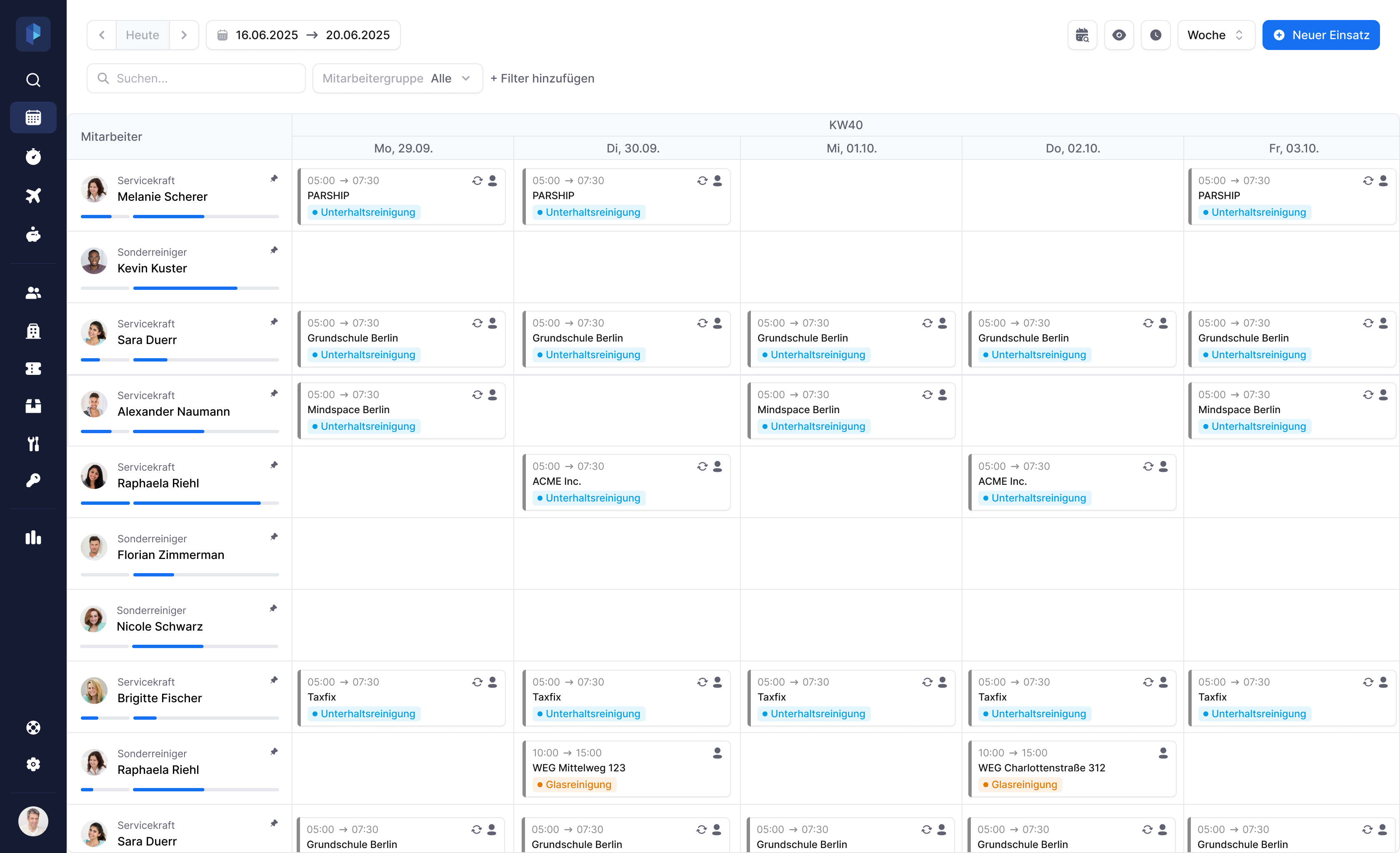
AI can optimize routes, allocate personnel more efficiently, and automatically adjust deployment schedules – for instance, in cases of sick leave, special assignments, or short-notice customer requests. Instead of manual rescheduling, AI supports dynamic real-time resource management.
Thanks to sensor technology and data analysis, cleaning intervals can be intelligently managed. Rooms are no longer cleaned rigidly according to a schedule, but based on actual need. This saves time, resources, and simultaneously improves quality.
Digital quality controls, automatic defect detection, or AI-supported evaluation of checklists help to reliably maintain standards and document processes transparently.
Quote generation, order entry, complaint management, or task distribution – many administrative activities can be accelerated or partially automated by AI. This holds enormous potential, especially for medium-sized cleaning companies.
An area that is often underestimated but offers enormous optimization potential is communication – especially over the phone.
Because this is precisely where bottlenecks often arise in the daily operations of many building cleaning companies:
In short: The phone is often a real productivity killer – even though it's also one of the most important customer touchpoints.
This is precisely where modern AI phone assistance comes in.
Unlike traditional answering machines or rigid phone menus, an AI assistant conducts real conversations, understands requests, asks follow-up questions, and processes information directly.
Whether during business hours, in the evening, or on weekends: an AI phone assistant answers every call, handles standard inquiries, and ensures no request goes unanswered.
Especially for new customer inquiries, this can be a significant revenue driver.
Instead of manually noting down information from phone calls, AI systematically requests relevant details:
The information is directly and systematically entered into the system and can be further processed.
Modern AI can not only conduct conversations but also initiate follow-up processes:
This significantly reduces friction.
Today, customers expect quick responses and professional availability. AI phone assistance helps deliver this service without placing an additional burden on your team.
Why is this particular technology so interesting for the industry?
Because building cleaning is extremely operational. Many decisions are made on the go, teams are rarely permanently in the office, and calls often come in precisely when no one is available to answer.
A specialized AI phone assistant can not only alleviate the burden but also actively improve processes.
And this is where it gets exciting: when AI doesn't just function generically, but has been developed specifically for building cleaning.
With Paula , PlanD brings PlanD this exact solution to the market – an AI phone assistant developed specifically for the needs of building cleaning companies and directly integrated into their all-in-one software.
Paula handles incoming calls reliably and professionally – whether new customer inquiries, complaints, callbacks, or internal matters. Every call is answered immediately, processed in a structured manner, and thoroughly documented – even outside regular business hours.
The big difference: Paula isn't just a digital phone service; she's an intelligent process component.
Instead of rigid standards, Paula works with individual workflows and templates that can be precisely tailored to your company's processes.
You define:
From forwarding to the right contact person to the automatic creation of tasks in the system, Paula handles everything in real-time in the background.
A special highlight is the automatic transcription and further processing of all conversations.
Calls are directly converted into:
Misunderstandings, forgotten information, or duplicate work are significantly reduced.
Whether prospect, existing customer, or employee – Paula recognizes different concerns and reacts accordingly.
She can:
And through targeted prompting, Paula continuously improves and becomes even more precisely tailored to operational processes.
Artificial intelligence isn't changing the cleaning industry sometime in the future – it's already doing it today.
From smart planning and process automation to intelligent customer communication, new opportunities arise to work more efficiently, improve service, and actively address the skilled labor shortage.
Particularly in phone assistance, it becomes clear how practical and immediate AI can deliver real added value.
With Paula , PlanDshows what this future specifically looks like – especially for cleaning companies, directly applicable in everyday operations, and with a true industry focus.
Free, no-obligation consultation with one of our digitalization experts.